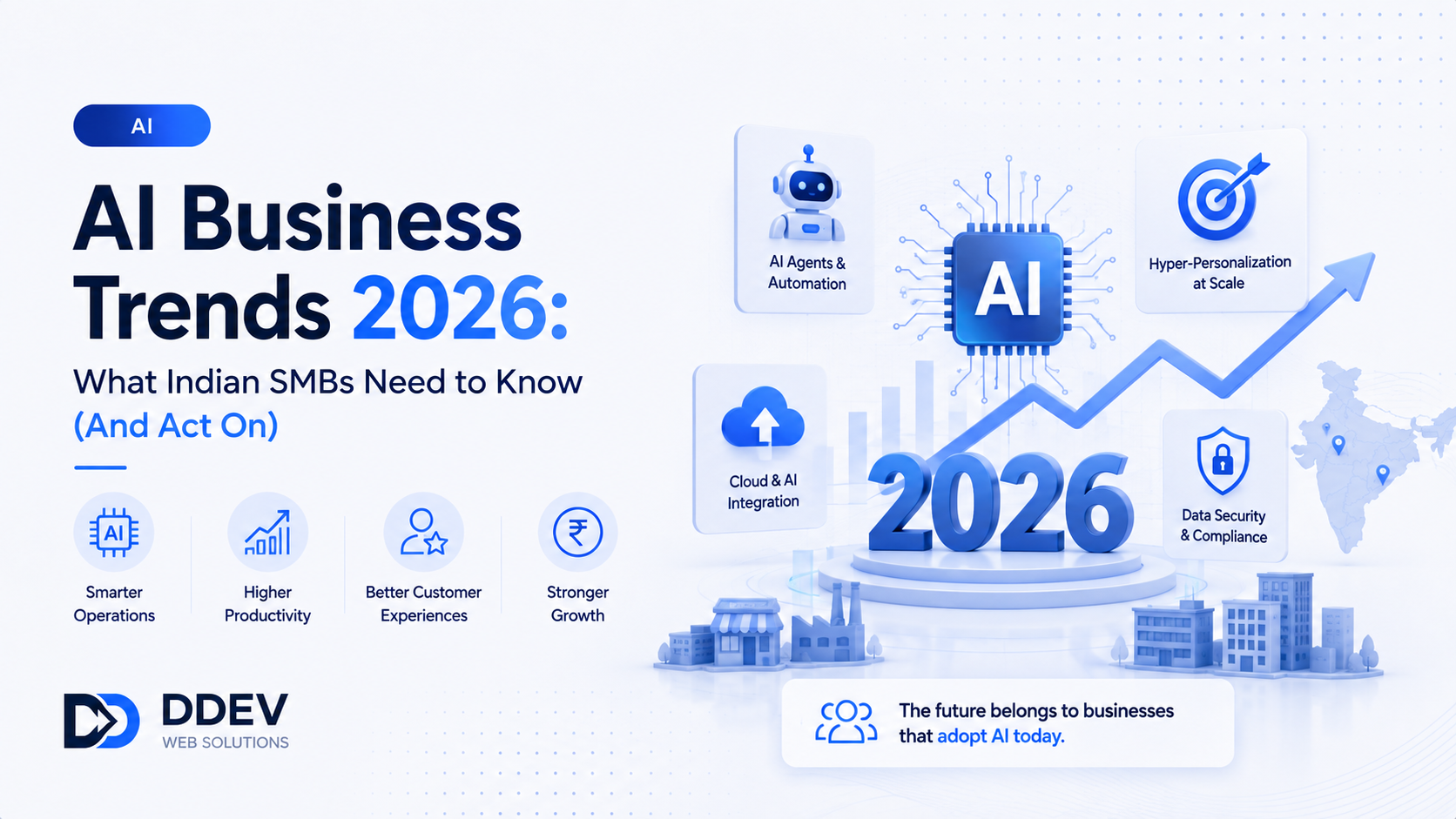
AI Business Trends 2026: What Indian SMBs Need to Know (And Act On)
India now leads global SMB AI adoption at 59%. Here is what is actually driving that number, where the real ROI is, and what small businesses should do next.
Somewhere in the last two years, the AI conversation quietly flipped for small businesses. It stopped being a question of "should we try this?" and became a question of "how far behind are we?"
The data backs this up in a way that is easy to miss if you are not looking closely. India now leads global small and mid-sized business AI adoption, with a majority of Indian SMBs already using AI-driven tools in some part of their operations — ahead of the US and most other major economies. That is not a small statistic. It means the businesses you are competing with locally — the clinic down the road, the coaching institute across town, the hotel two streets over — are more likely than not already experimenting with AI in some form.
But adoption and advantage are not the same thing. Most of that usage is still shallow — a chatbot here, an AI writing assistant there. The businesses actually pulling ahead are the ones using AI in ways that touch revenue directly, not just convenience.
This piece breaks down what is actually happening, where the real returns are showing up, and what an SMB owner should realistically do about it.
India Is Leading, Not Following
For years, the assumption was that India would adopt enterprise technology years after the US and Europe. AI adoption is breaking that pattern.
Indian MSMEs have spent the last decade moving through digital transformation in stages — UPI, GST compliance, e-commerce marketplaces, cloud software. That groundwork is now paying off. A large share of India's MSMEs are actively exploring or implementing AI, and by most measures, Indian small business AI adoption now outpaces the US and other major markets.
There is a simple reason for this: Indian SMBs had less legacy infrastructure to unwind. A US small business might be migrating off a 15-year-old on-premise system. An Indian business, having digitized more recently, is often adding AI onto systems that are already cloud-based and only a few years old. Less friction, faster adoption.
The practical implication: if your business has not started experimenting with AI in some form, you are increasingly the exception, not the norm, among your competitors.
The Gap Between "Using AI" and "Getting Value From AI"
Here is the part most coverage of AI adoption glosses over.
Across small business surveys globally, a majority of SMB owners describe themselves as still "exploring" AI rather than having built it into how the business actually runs. Adoption numbers count anyone who has tried an AI tool even once. Real, embedded usage — AI that is now part of a daily workflow, tied to a measurable outcome — is a much smaller slice.
This creates two groups:
AI explorers — testing tools, using a chatbot occasionally, generating some marketing copy with AI. Real, but shallow. No structural change to how the business operates.
AI operators — businesses that have built AI into a specific, recurring workflow: automated lead follow-up, AI-assisted customer support, appointment scheduling, content generation tied to an actual content calendar. These businesses report measurable time and cost savings, not just novelty value.
The gap between these two groups is where competitive advantage is actually being built right now. Being an "explorer" for another year is a low-risk, low-reward choice. It also means the businesses that move to "operator" status this year get a head start that compounds.
Where the Real ROI Is Showing Up
Across small business AI surveys, one use case dominates every other: marketing and customer engagement. The overwhelming majority of SMBs using AI meaningfully are using it for exactly this — writing marketing copy, running customer support conversations, personalizing follow-ups, and automating the repetitive parts of customer communication.
This lines up with what should be intuitive. Marketing and customer engagement are high-volume, repetitive-enough-to-automate, and directly tied to revenue. It is the easiest place to see AI pay for itself quickly.
Businesses using AI meaningfully report saving a significant number of hours per month — commonly in the range of 20+ hours — and translating a portion of that time savings into direct cost reduction. A smaller but still substantial share report AI directly contributing to revenue growth, primarily through faster response times, more consistent follow-up, and content that would otherwise never have gotten made due to time constraints.
For an Indian SMB — a clinic, a coaching institute, a restaurant, a real estate agency — this translates concretely: faster WhatsApp response to enquiries, automated appointment reminders, AI-assisted content for local SEO, and chat-based lead qualification before a human ever gets involved.
The MSME Priority Shift
A revealing pattern in recent Indian MSME research: operational efficiency has overtaken both revenue growth and customer acquisition as the top stated business priority for a majority of MSMEs. Cybersecurity readiness is close behind, and AI adoption is explicitly named as part of how businesses plan to get there.
This is a shift in mindset, not just tooling. For years, small businesses treated technology spend as something you did once you were already growing — a website once you had customers, software once you had staff to manage. The current pattern flips that: MSMEs are treating AI and digital infrastructure as the mechanism that gets them to growth, not the reward for having already arrived.
Practically, this means the businesses gaining ground right now are not necessarily the ones with the biggest budgets. They are the ones treating their digital and AI infrastructure — website, booking systems, customer communication, content — as core operations, not an afterthought.
The Blind Spot: Nobody Is Ready for AI Search
Here is the trend that gets the least attention, and it matters enormously for how customers find your business going forward.
A meaningful share of customers — and this share is growing every quarter — now start their research not on Google, but inside an AI assistant. "Best dermatologist near me," "which coaching institute has the best JEE results in my city," "should I book this hotel or that one" — these questions increasingly get asked directly to ChatGPT, Gemini, or Google's AI Overviews, not typed into a traditional search box.
Yet a large share of businesses — brands included, not just SMBs — currently have no strategy at all for how they appear (or fail to appear) in AI-generated answers. AI assistants form their answers based on structured web content, consistent business information, and third-party validation like reviews — much of which most small business websites simply do not provide in a form AI can use.
This is the single biggest gap between "using AI internally" and "being visible in an AI-driven world" — and almost nobody is addressing the second half yet. The businesses that fix this now, while competitors are focused only on internal AI tools, get a multi-year head start in a channel that is only going to grow.
What This Means for Your Business
If you run a small or mid-sized business in India right now, here is the realistic read.
You are not early anymore. A majority of your local competitors have already tried some form of AI. Being a non-adopter is now the outlier position, not the safe one.
Shallow adoption is not an advantage. Using a chatbot once or generating a few social posts with AI puts you in the same bucket as most of your competitors. The advantage comes from embedding AI into a specific, repeatable part of your operations — customer response time, appointment management, content consistency.
Marketing and customer engagement is the highest-ROI starting point. If you are deciding where to start, this is where the data says to start. Faster response times and consistent follow-up compound into real revenue.
Your website and digital infrastructure are the foundation, not an accessory. Every AI workflow — automated booking, WhatsApp follow-up, AI-visible content — needs a properly built digital foundation to plug into. A slow, static, brochure-style website cannot support any of this.
AI search visibility is the next frontier, and almost nobody has started. This is the highest-leverage, lowest-competition move available right now — not because it is complicated, but because almost no one is doing it yet.
Frequently Asked Questions
Is India really ahead of other countries in small business AI adoption?
By several measures, yes — a majority of Indian SMBs report already using AI-driven tools in some part of their operations, putting India ahead of the US and other major markets on this specific metric. This is largely attributed to Indian businesses having digitized more recently, with less legacy infrastructure to work around.
What is the single best place for a small business to start with AI?
Marketing and customer engagement, based on where SMBs consistently report the strongest returns. This includes AI-assisted customer response (WhatsApp/chat), automated follow-up, and AI-supported content creation for your website and local SEO.
Do I need a big budget to start using AI in my business?
No. Most of the highest-ROI use cases — automated appointment reminders, WhatsApp chat automation, AI-assisted content — cost a fraction of what a full custom software build costs, and many can be layered onto a website you already have or are building.
What is "AI search visibility" and why does it matter?
It refers to how well your business appears when customers ask AI assistants (ChatGPT, Gemini, Google AI Overviews) questions instead of typing a traditional Google search. It depends on structured website content, consistent business information across platforms, and strong reviews — most of which current small business websites are not built to provide.
Build the Infrastructure Your AI Strategy Actually Needs
DDev builds AI-ready websites and digital infrastructure for Indian businesses — fast, structured, and built to work with automated booking, customer communication, and AI search visibility, not just look good.
Talk to DDev About Your AI Strategy.