
Secure Patient Portals in India: What DPDP & Compliance Mean for Your Clinic Website
WhatsApp and Gmail are not secure enough for patient data. Here is what a compliant patient portal requires — and why your clinic needs one.
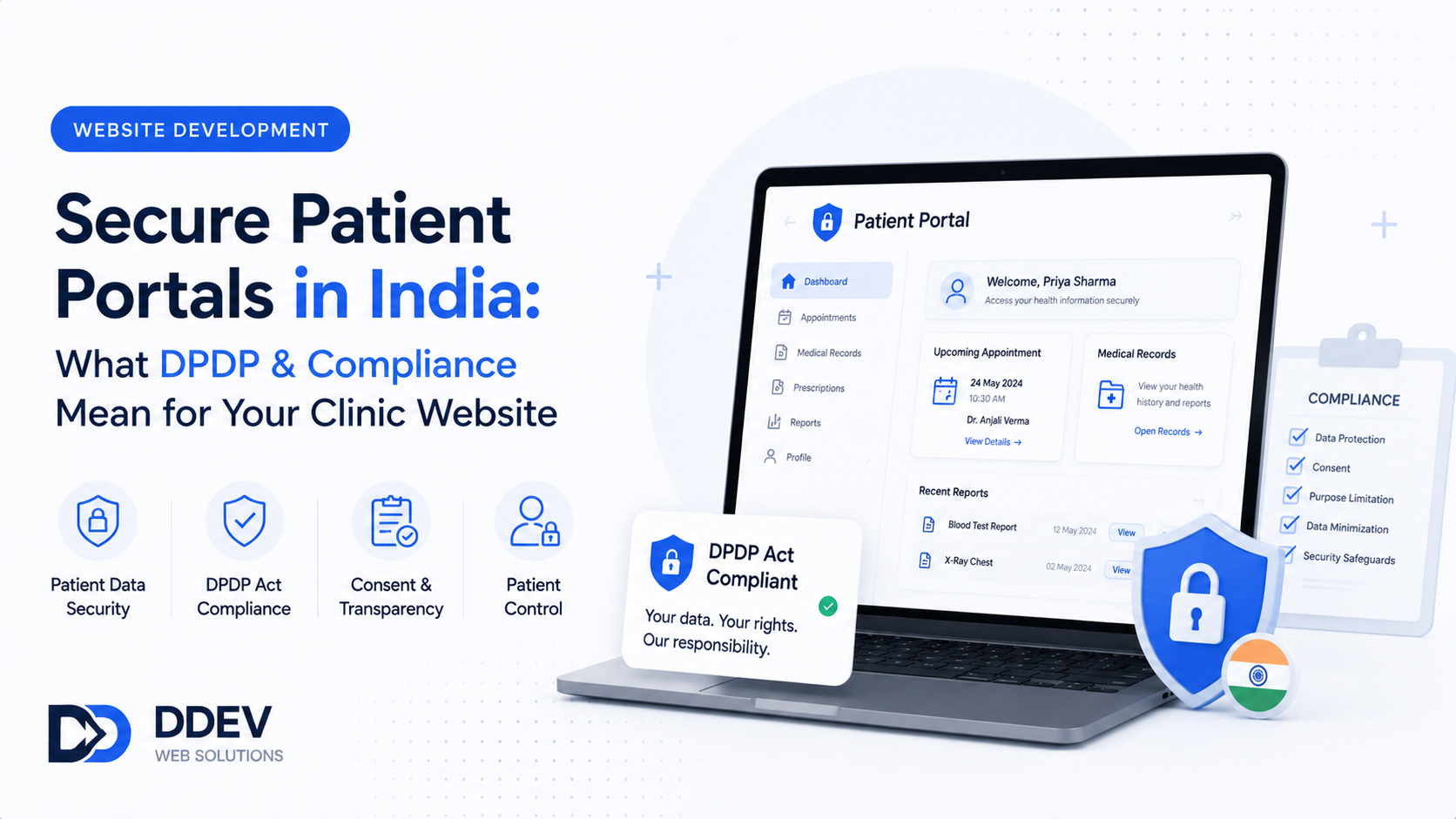
Here is how most clinics in India share patient reports right now:
A lab result gets scanned, attached to a WhatsApp message, and sent to the patient's personal number. A prescription gets emailed from the doctor's Gmail. Follow-up instructions are texted via SMS.
It works. Patients get their information. Nothing seems broken.
Except that every one of those channels puts a third party — Meta, Google, a telecom operator — in the middle of a confidential medical communication. The data sits on servers you do not control, under terms of service designed for consumer messaging, not healthcare.
This was always a gray area. With India's Digital Personal Data Protection (DPDP) Act now in effect, it is becoming a liability.
A secure patient portal is not a luxury feature for large hospitals. It is the infrastructure that any clinic handling patient records digitally needs — to protect patients, protect itself, and operate professionally.
The WhatsApp and Gmail Problem
WhatsApp and Gmail are excellent communication tools. They are not healthcare infrastructure.
Here is why the distinction matters:
No access control. Anyone with access to the patient's phone (family members, colleagues, a lost device) can see medical information shared via WhatsApp. There is no role-based access, no login requirement, and no audit trail of who viewed what.
No encryption at rest for attachments. WhatsApp encrypts messages in transit, but attachments saved to the phone's gallery sit unencrypted on the device. A shared lab report is now a file that can be forwarded, screenshotted, or accessed by any app with storage permissions.
No data retention control. Once you send a report via WhatsApp, you have no ability to delete it from the recipient's device, manage how long it is stored, or revoke access if needed. Consumer platforms were not designed for controlled data lifecycle.
No audit trail. If a data breach occurs, you have no log of who accessed which patient record and when. Consumer email and messaging platforms do not provide the kind of audit logging that healthcare data handling requires.
Compliance gap. India's DPDP Act requires data fiduciaries (which includes healthcare providers handling patient data) to implement appropriate security safeguards, ensure data accuracy, and provide mechanisms for patients to access and manage their data. Consumer messaging platforms do not give you the controls to demonstrate compliance.
None of this means WhatsApp is evil or that every clinic using it is at immediate legal risk. But as regulations tighten and digital health records become standard, the gap between "what WhatsApp provides" and "what healthcare data handling requires" will widen.
What Is a Patient Portal (And What It Is Not)
A patient portal is a secure, web-based platform where patients can access their medical information through authenticated login.
What it does:
- Patients log in with credentials (username/password, OTP, or biometric)
- They access their test results, prescriptions, visit summaries, and billing
- They can book appointments, request refills, or message their doctor
- Everything happens within a controlled, encrypted environment
- The clinic controls access, retention, and data lifecycle
What it is not:
- It is not a chat app. It is a secure document and communication system.
- It is not public-facing. Only authenticated patients and authorized staff access it.
- It is not a replacement for in-person care. It is the digital layer that makes the rest more efficient.
Think of it as the difference between sending a letter (WhatsApp) and using a bank's online portal (patient portal). Both move information — but one has security, authentication, and audit controls built in.
Data Protection in India: The DPDP Context
India's Digital Personal Data Protection Act, 2023 (DPDP Act) establishes a framework for how organizations handle personal data. Healthcare data is among the most sensitive categories.
Key requirements relevant to clinics:
Consent: You need clear, informed consent before collecting and processing patient data. A patient portal with explicit consent mechanisms (checkboxes, consent forms at registration) helps document this.
Purpose limitation: Patient data should be used only for the purpose it was collected. A portal with defined access controls ensures data stays within the healthcare context.
Security safeguards: The Act requires "reasonable security safeguards" to prevent breaches. Encryption, access controls, and audit logging — standard features of a properly built portal — demonstrate compliance.
Data principal rights: Patients have the right to access their data, correct it, and request erasure. A portal provides a natural mechanism for exercising these rights.
Breach notification: If a breach occurs, you need to notify the Data Protection Board. Having proper logging and access controls makes breach detection and reporting possible — something you cannot do with WhatsApp.
The specific rules and enforcement framework are still evolving. But the direction is clear: digital health data needs proper infrastructure, not consumer messaging workarounds.
What a Secure Patient Portal Actually Requires
Building a patient portal is not about adding a login page to your website. Here are the actual requirements:
Authentication
Patients access the portal via secure login — password + OTP (two-factor authentication). No anonymous access. Every session is authenticated and logged.
Encryption
Data is encrypted both in transit (SSL/TLS) and at rest (AES-256 or equivalent). This means even if someone intercepts the data or accesses the server, the information is unreadable without the encryption key.
Role-Based Access Control
Not everyone sees everything. The doctor sees clinical records. The receptionist sees appointment data. The billing team sees payment information. The patient sees their own records only. Access is scoped to role and need.
Audit Logging
Every action — login, file access, download, share — is logged with timestamp, user identity, and IP address. If a question ever arises about who accessed a record, the log provides the answer.
Secure Document Storage
Reports, prescriptions, and images are stored in the clinic's controlled infrastructure (or a healthcare-grade cloud), not on a consumer platform's servers. Retention policies define how long data is kept.
Session Management
Automatic logout after inactivity. Session tokens that expire. Protection against session hijacking.
What Patients Get Out of It
Patient portals are not just a compliance exercise. They improve the patient experience.
24/7 access to records. Patients can view their lab results, prescriptions, and visit history anytime — no need to call the clinic during business hours.
No more lost reports. Everything is stored digitally and accessible via login. No more digging through WhatsApp for a report sent 6 months ago.
Easy appointment booking. Self-scheduling integrated into the portal means patients can book, reschedule, or cancel without phone calls.
Direct communication with the doctor. Secure messaging within the portal replaces informal WhatsApp chats with a documented, private communication channel.
Faster visits. When intake forms and history are already in the portal, in-clinic time is spent on care, not paperwork.
What Clinics Get Out of It
Compliance readiness. As data protection enforcement in India matures, clinics with proper portals are already compliant. Those relying on WhatsApp face increasing risk.
Reduced admin burden. Patients access their own records, book their own appointments, and fill their own intake forms. Your front desk handles exceptions, not routine tasks.
Professional perception. A clinic with a secure portal signals modernity, competence, and care. In a market where patients increasingly evaluate clinics online before visiting, this matters.
Competitive advantage. Most clinics in India — especially independent practices and small chains — do not have patient portals. Implementing one now puts you ahead of the majority of your competitors.
Better patient retention. Patients who have their records, history, and communication in one place are less likely to switch providers. The portal creates a switching cost that benefits the clinic.
Frequently Asked Questions
Is WhatsApp illegal for sharing patient reports in India?
Not currently illegal in most cases, but it is increasingly out of alignment with the DPDP Act's requirements for security safeguards, access controls, and data lifecycle management. As enforcement matures, the gap between what WhatsApp provides and what regulations require will create compliance risk.
How much does a patient portal cost?
A secure patient portal integrated into a clinic website typically costs ₹80,000–₹2,50,000 to build, depending on complexity (number of features, integrations with existing systems). Ongoing costs are ₹3,000–8,000/month for hosting, maintenance, and security updates.
Do patients actually use portals in India?
Adoption is growing, especially among urban patients under 50. The key is making the first experience smooth — if the portal is faster and more convenient than calling the clinic, patients adopt it. Clinics report 30–60% portal adoption within the first year when onboarding is done well.
Can a small clinic with 2–3 doctors justify a portal?
Yes. A portal reduces admin work (fewer phone calls, automated reminders, self-booking), improves patient experience, and positions the clinic professionally. The ROI comes from time saved and patient retention, not just compliance.
What about integrating with existing hospital management systems?
A well-built portal can integrate with existing HMS/EHR systems via APIs. If your current system is entirely paper-based, the portal serves as the starting point for digitization.
Protect Your Patients. Protect Your Practice.
DDev builds secure patient portals for clinics — encrypted, DPDP-aware, with role-based access, appointment booking, and digital records. Professional healthcare infrastructure, not WhatsApp workarounds.
Talk to DDev About Your Secure Patient Portal.