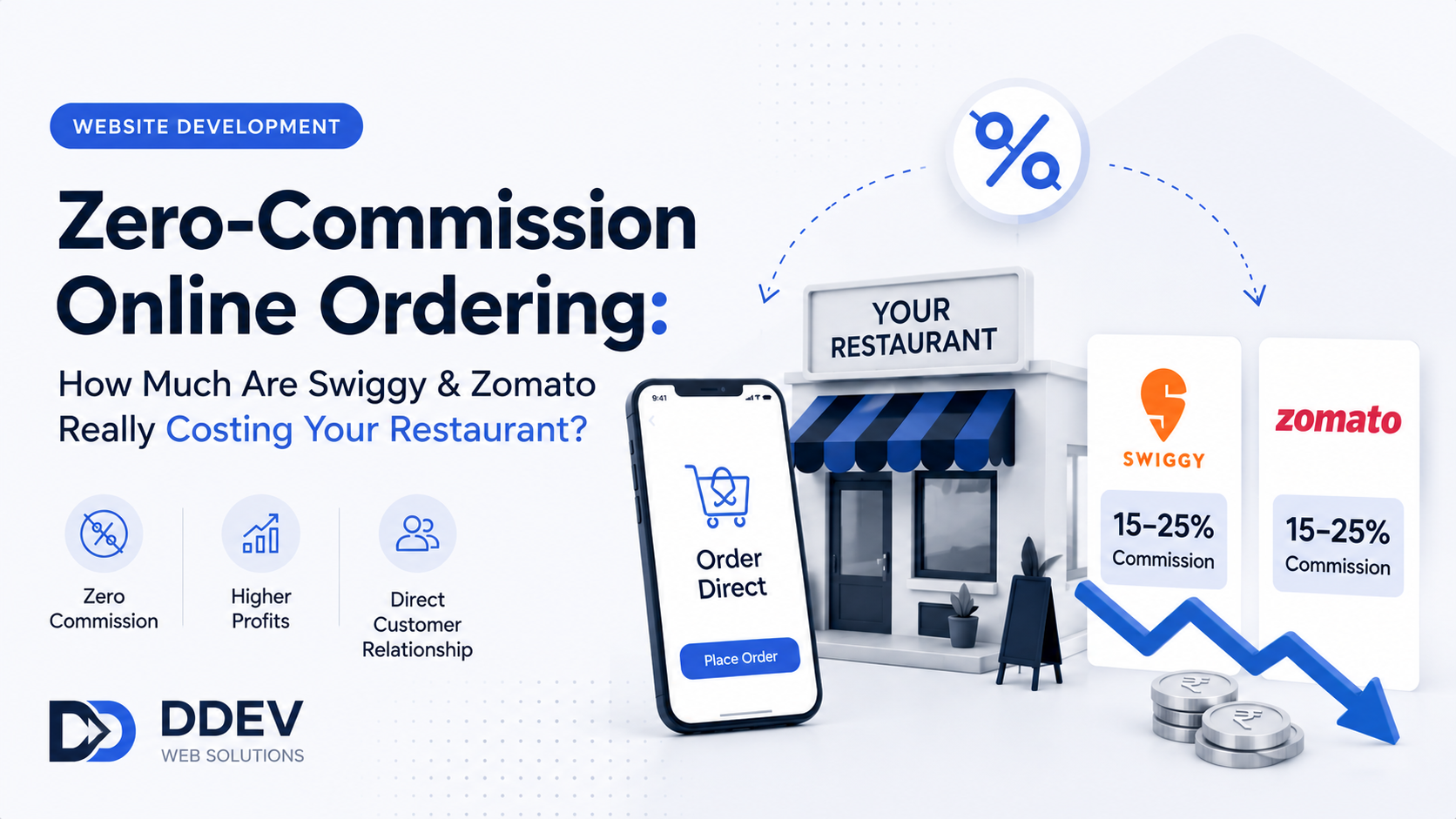
Zero-Commission Online Ordering: How Much Are Swiggy & Zomato Really Costing Your Restaurant?
Swiggy and Zomato take 18–30% per order. See the real math, hidden fees, and how to build a commission-free ordering channel on your own website.
You know the number Swiggy quoted when you signed up. Maybe it was 22%. Maybe 18% if you negotiated hard.
That number is a lie. Not technically — but practically.
By the time you add platform fees, payment gateway charges, discount funding, GST on service fees, and the promotional spend they nudge you toward every week, the real deduction on a ₹500 order lands somewhere between ₹125 and ₹190.
That is 25–38% of your revenue. Gone. Before you have paid for ingredients, rent, gas, or a single salary.
If your kitchen runs on a 12–15% net margin — which is generous for most independent restaurants in India — you are either breaking even on delivery orders or quietly losing money on every one.
This piece breaks down the exact math, explains why aggregators still have a role, and shows what it looks like to build a commission-free ordering channel on your own domain.
The Commission Nobody Talks About Honestly
Here is what Zomato and Swiggy actually charge in 2026.
Base commission rates:
- Zomato: 18–28% (varies by city, cuisine, volume, and your negotiated contract)
- Swiggy: 17–25% (same variables)
Non-exclusive, multi-chain listings typically start at around 22%.
But the base commission is just the starting line. Stack these on top:
Platform fee: Both Swiggy and Zomato hiked per-order platform fees to ₹17.58 in March 2026. On a ₹400 order, that is another 4.4%.
Payment gateway fee: 1.9–2% of order value.
GST on platform fees: 18% GST applied on the commission and service charges — not on the food, on the platform's cut.
Discount funding: Platforms expect restaurants to fund 50–100% of customer-facing discounts. That "Flat ₹125 Off" promo? Half of it (or all of it) comes from your pocket.
Promotional spend: Sponsored listings, banner ads, priority placement. Optional in theory. Necessary for visibility in practice.
The real number: After all deductions, effective costs typically land in the 25–35% range per order.
The Real Math: What You Actually Pay Per Order
Take a ₹500 order on Zomato.
| Cost Component | Amount | % of Order |
|---|---|---|
| Base commission (22%) | ₹110 | 22% |
| Platform fee | ₹17.58 | 3.5% |
| Payment gateway (2%) | ₹10 | 2% |
| GST on platform charges | ₹23 | 4.6% |
| Discount funding (50% of ₹125 off) | ₹62.50 | 12.5% |
| Total deductions | ₹223 | 44.6% |
Even without discount funding, the deductions hit ₹160 — or 32% of the order.
You take home ₹277 to ₹340 from a ₹500 order.
Now factor in food cost (30–35% of order value = ₹150–175), packaging (₹15–25), and the kitchen's share of rent, utilities, and labor.
The margin on that aggregator order? It is either razor-thin or negative.
A Worked Example: ₹4 Lakh Monthly Revenue
Imagine a small restaurant doing ₹4,00,000 per month through Swiggy and Zomato combined. Roughly 800 orders at ₹500 average.
What the aggregator takes (at 28% effective cost):
₹4,00,000 × 28% = ₹1,12,000 per month
That is ₹13,44,000 per year. Gone to the platform.
What a direct ordering channel costs:
A branded website with an ordering system, payment gateway, and basic WhatsApp integration costs a one-time build fee (anywhere from ₹40,000 to ₹1,50,000 depending on complexity) plus hosting and maintenance (₹2,000–5,000/month).
Let us say the total first-year cost is ₹1,00,000.
If you shift just 30% of your orders — 240 orders per month — to direct, you save:
240 × ₹500 × 28% = ₹33,600/month or ₹4,03,200/year
The website pays for itself in under three months. Everything after that is pure margin recovery.
Why Aggregators Still Make Sense (For Discovery)
This is not an "abandon Zomato" argument.
Aggregators are excellent at one thing: putting your restaurant in front of people who do not know you exist. They are discovery engines. That is genuinely valuable, especially for new restaurants or those expanding into new delivery zones.
The problem starts when aggregators become your only channel — when 100% of delivery revenue flows through a platform that takes 25–35% of it and owns the customer relationship.
The smartest operators use aggregators for acquisition and their own website for retention:
- A new customer discovers you on Swiggy. Fine.
- Their first order includes a card or QR code linking to your direct ordering page with a 10% loyalty discount.
- Their second order (and every order after) happens on your channel at zero commission.
This blended approach — aggregator for discovery, own channel for repeat — brings your effective commission down to 12–15% across all orders. That is manageable.
What Commission-Free Ordering Actually Looks Like
A commission-free ordering system on your own website works like this:
-
Your menu lives on your domain — not on a third-party marketplace. You control pricing, photos, descriptions, and availability.
-
Customers order directly — through your website or a WhatsApp integration. Payment goes through a standard gateway (Razorpay, Cashfree) at 2% transaction fee. No platform commission.
-
You own the customer data — phone numbers, order history, preferences. You can re-market via WhatsApp, SMS, or email. On Zomato, the customer belongs to Zomato.
-
Delivery is handled by you or a logistics partner — services like Shadowfax, Dunzo, or Porter charge per-delivery fees (₹25–60 depending on distance), which is predictable and far cheaper than a percentage-based commission.
Your cost per order drops from ₹160–220 (aggregator) to ₹35–70 (direct). That difference is your margin.
How to Build Your Own Direct Ordering Channel
You do not need a massive budget or a tech team. Here is the minimum viable setup:
Step 1: A fast, mobile-first website with your menu
80%+ of food orders happen on phones. Your site needs to load in under 3 seconds, display your menu clearly, and have a visible "Order Now" button.
Step 2: Online ordering with payment integration
Customers should be able to browse, add to cart, and pay — UPI, cards, or cash on delivery. Razorpay and Cashfree integrate easily and charge flat 2% per transaction.
Step 3: WhatsApp ordering as a parallel channel
For customers who prefer messaging, a click-to-WhatsApp button with a pre-formatted order template works surprisingly well. WhatsApp has 97%+ open rates in India — far higher than email or SMS.
Step 4: A loyalty program or repeat incentive
Even something simple — "Order direct and get 10% off your 5th order" — shifts behavior over time.
Step 5: In-restaurant nudges
Table cards, bill inserts, packaging stickers, and QR codes that link to your direct ordering page. Every dine-in customer should leave knowing how to order from you directly.
The Customer Data Problem Nobody Mentions
Here is the part that matters more than commission in the long run.
When a customer orders from you on Swiggy, Swiggy owns that customer. You do not get their phone number, email, or order history. You cannot message them, offer loyalty rewards, or run a birthday promotion.
If Swiggy changes its algorithm tomorrow and buries your listing, those customers vanish. You rented them; you never owned them.
With a direct ordering channel, every customer who orders becomes yours:
- You know what they ordered, when, and how often
- You can send a WhatsApp message when you launch a new dish
- You can offer a discount during slow hours to fill empty tables
- You build a re-marketable database that compounds in value every month
This database — your owned customer list — is the single most valuable digital asset a restaurant can build. And aggregators will never give it to you.
Frequently Asked Questions
How much commission does Zomato charge in 2026?
Zomato's base commission ranges from 18–28% depending on your city, cuisine type, and negotiated contract. But after adding platform fees (₹17.58 per order), payment gateway charges (2%), GST on fees, and any discount funding, the effective deduction often lands between 25–35% of order value.
How much commission does Swiggy charge?
Swiggy's base commission runs 17–25%, with the same stack of additional charges. Effective costs are comparable to Zomato — typically 25–35% all-in.
Can I negotiate my aggregator commission?
Yes. Restaurants doing 50+ orders per day with strong ratings and high AOV have leverage. Most operators report negotiating 2–5 percentage points off the base rate. Come with your monthly order data and, ideally, a competing platform's offer.
What does a commission-free ordering website cost?
A branded restaurant website with online ordering, payment integration, and WhatsApp ordering typically costs ₹40,000–₹1,50,000 to build, with ₹2,000–5,000/month in hosting and maintenance. It usually pays for itself within 2–4 months through saved commission.
Should I completely leave Zomato and Swiggy?
No. Use aggregators for customer discovery — they are genuinely good at putting you in front of new customers. But shift repeat customers to your direct channel using incentives, QR codes, and loyalty rewards. The target is a blended 12–15% effective commission across all orders.
How do I handle delivery without an aggregator?
Third-party logistics partners like Shadowfax, Dunzo, or Porter handle delivery at flat per-order rates (₹25–60 depending on distance). This is predictable and much cheaper than percentage-based aggregator commissions.
Ready to Stop Paying 25–35% on Every Order?
DDev builds commission-free ordering systems for restaurants — fast, mobile-first websites with online ordering, WhatsApp integration, and payment processing on your own domain. You keep the revenue. You own the customer.
Talk to DDev About Your Restaurant.