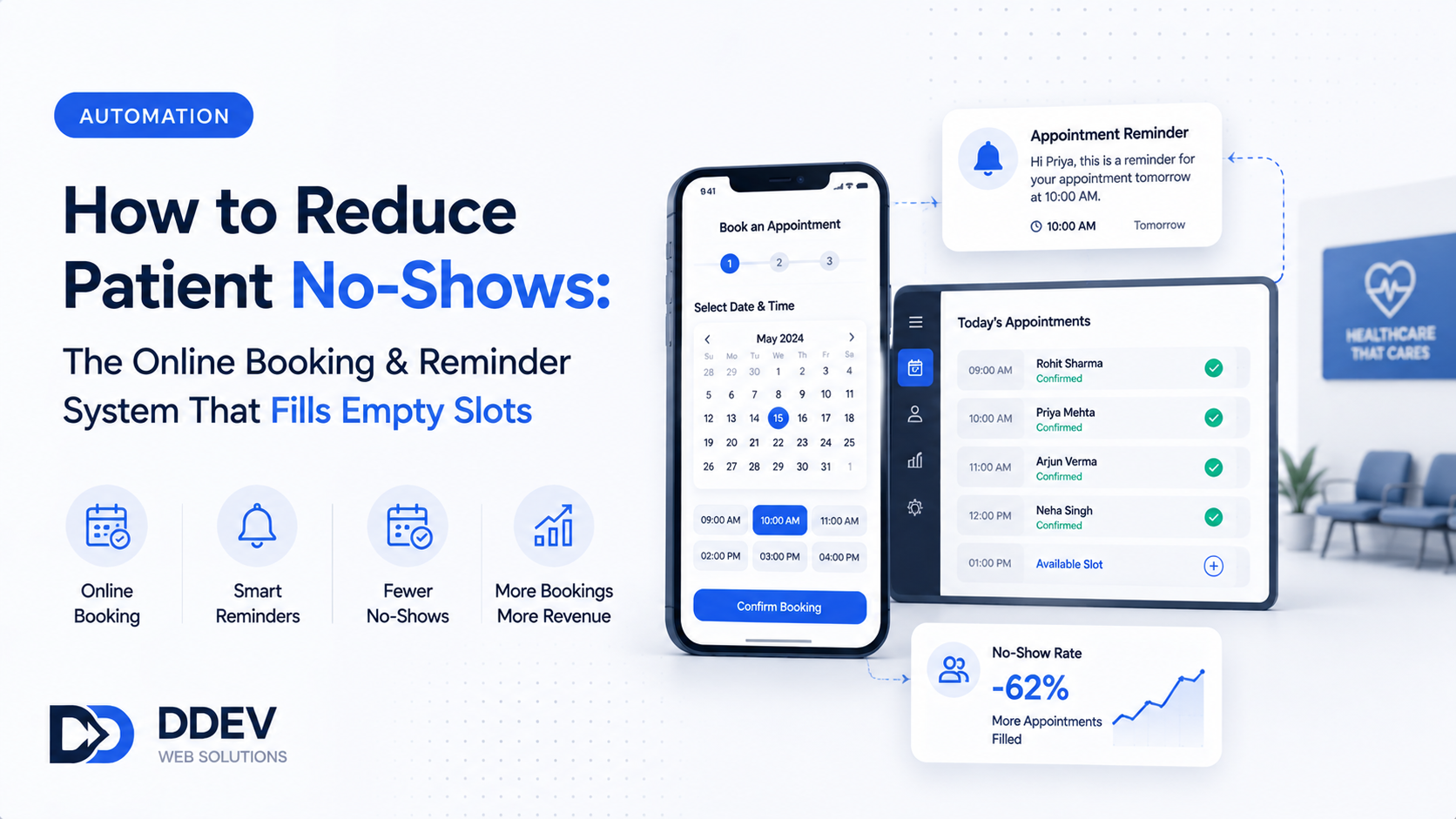
How to Reduce Patient No-Shows: The Online Booking & Reminder System That Fills Empty Slots
Every missed appointment costs your clinic ₹800–2,500. Learn how automated reminders and online self-scheduling cut no-shows by 14–38%.
Every clinic has the same quiet problem.
You look at today's schedule: 25 appointments booked. You staff for 25. You prepare for 25. By end of day, 4–5 patients did not show up.
That is a 16–20% no-show rate. And it is the industry average across outpatient clinics in India.
Each of those empty slots represents lost revenue — somewhere between ₹800 and ₹2,500 per missed appointment depending on the consultation type. For a clinic seeing 30 patients a day with a 15% no-show rate, that is roughly ₹1–1.5 lakh in monthly revenue that simply disappears.
The staff was paid. The room was allocated. The doctor's time was blocked. The cost was incurred — the revenue was not.
The good news: no-shows are not random acts of nature. They follow predictable patterns, and two specific interventions — automated reminders and online self-scheduling — consistently cut no-show rates by 14–38% across documented studies.
The Real Cost of an Empty Chair
No-shows cost more than the missed consultation fee. The real damage is compounding:
Direct revenue loss: ₹800–2,500 per missed appointment. For a 30-patient-per-day clinic with 15% no-shows, that is 4–5 missed appointments daily. At ₹1,500 average, you lose ₹6,000–7,500 per day — roughly ₹1.5–1.8 lakh per month.
Wasted capacity: The doctor, nurse, and room were allocated. You cannot backfill a slot that no-shows 10 minutes before the appointment.
Longer wait times for other patients: Empty slots mean you could have seen patients who actually wanted to come — but were told no availability. You turned away real demand because phantom demand occupied the slot.
Delayed care for the no-show patient: Patients who miss appointments often delay follow-ups, leading to worse outcomes — which eventually leads to more expensive, urgent visits.
Staff frustration and scheduling chaos: Frequent no-shows make it impossible to predict daily workload. Staff either sits idle or scrambles to reorganize.
Why Patients Miss Appointments
Understanding the reasons is critical because different causes need different solutions.
Forgetfulness — the #1 reason. Patients book an appointment, and by the time the date arrives, they have forgotten. This is especially common when the appointment is booked more than a week in advance. Automated reminders solve this almost entirely.
Inconvenient timing. The patient booked at a time that seemed fine initially but became inconvenient. A meeting came up. A school event. A family obligation. Online rescheduling lets them move the appointment instead of ghosting it.
Feeling better. For non-chronic conditions, patients who feel symptom relief often skip follow-up appointments. Pre-visit education ("here is why this follow-up matters") helps here.
Cost anxiety. Some patients worry about costs and avoid the visit rather than ask. Transparent pricing on your website reduces this friction.
Difficulty reaching the clinic to cancel. If canceling requires calling during business hours and navigating a busy phone line, many patients just do not show up instead. Easy cancellation — via WhatsApp, SMS, or a link — converts no-shows into cancellations, which you can then fill.
Automated Reminders: The Single Biggest Lever
Automated appointment reminders are the most effective single intervention for reducing no-shows. Studies consistently report reductions in the 14–38% range when automated reminders are implemented.
What works
WhatsApp reminders: India-specific advantage. WhatsApp has 97%+ open rates in India, far higher than SMS (20–30%) or email (15–25%). A WhatsApp reminder 24 hours before the appointment, with a "Confirm / Reschedule / Cancel" button, is the highest-engagement format available.
SMS reminders: Still effective, especially for patients who are less active on WhatsApp. A simple text — "Dr. Sharma expects you tomorrow at 10:30 AM. Reply C to confirm, R to reschedule" — takes seconds to read.
Multi-touch sequence: The most effective approach combines multiple touchpoints:
- At booking: Instant confirmation via WhatsApp/SMS with appointment details
- 48 hours before: First reminder with a "Confirm" button
- 24 hours before: Second reminder — "We are looking forward to seeing you tomorrow"
- 2 hours before: Final reminder for same-day confirmation
This sequence catches patients at different decision points. The first reminder jogs memory. The second creates a commitment. The third is the last-chance safety net.
The confirmation step matters
A reminder that asks for confirmation ("tap to confirm") is more effective than a passive notification. Once a patient actively confirms, they are significantly more likely to show up. It creates a micro-commitment.
Patients who do not confirm within the 24-hour window are your highest no-show risk — and this gives your staff a clear list to call directly.
Online Self-Scheduling: Booking When It Is Convenient
A large percentage of patients want to book appointments outside of clinic hours. If your only booking method is "call between 9 AM and 6 PM," you are losing patients who work during those hours, want to book at night or early morning, prefer not to make phone calls, or need to coordinate with family before committing to a time.
Online self-scheduling solves all of these.
How it works
A booking page on your clinic website shows available doctors and their specialties, available time slots synced with your actual schedule, and the ability to select, book, and receive instant confirmation. No phone calls. No waiting on hold. No back-and-forth.
Why it reduces no-shows
When patients choose their own appointment time — instead of being assigned one by a receptionist — they pick a time that actually works for them. This seemingly small shift reduces scheduling conflicts, which is one of the top reasons for missed appointments.
Self-scheduled appointments also create a stronger sense of ownership. The patient made an active choice rather than accepting whatever slot was offered.
Faster intake as a bonus
Pair online booking with digital intake forms — patient history, current medications, allergy information — that patients fill out before arriving. This cuts in-office paperwork, reduces wait times, and makes the appointment feel more respectful of the patient's time.
Patients who had a smooth, efficient experience are more likely to return and less likely to no-show in the future.
The Cancellation-and-Refill System
Here is a counterintuitive insight: you want to make canceling easy.
If canceling is hard (requires a phone call, involves guilt, is buried in a confusing process), patients do not cancel — they simply do not show up. You lose the slot with zero notice.
If canceling is easy (tap a link in a WhatsApp message, takes 5 seconds), patients cancel early — giving you time to fill the slot.
The refill workflow
- Patient cancels via WhatsApp or website (easy, one-tap)
- System immediately checks the waitlist for patients who wanted an earlier slot
- Waitlisted patient receives a "Slot available — book now?" notification
- Slot is filled within hours instead of sitting empty
This turns every cancellation into a refill opportunity rather than a lost slot. The net effect on no-shows is dramatic.
Building the Complete No-Show Prevention Stack
Here is the full system, from cheapest to implement to most sophisticated:
Tier 1: Basic (works for any clinic)
- WhatsApp reminder 24 hours before appointment (manual or semi-automated)
- Easy cancellation via WhatsApp reply
- Google Business Profile with booking link
Expected no-show reduction: 10–15%
Tier 2: Standard (recommended)
- Automated multi-touch reminders (WhatsApp + SMS at 48h, 24h, 2h)
- Online self-scheduling on clinic website
- Confirmation-request system with follow-up calls for unconfirmed
- Digital intake forms sent before appointment
Expected no-show reduction: 20–30%
Tier 3: Advanced
- Everything in Tier 2
- Automated waitlist with real-time slot refilling
- Predictive no-show scoring (flag high-risk appointments based on patient history)
- Patient portal for test results, prescriptions, and follow-up booking
Expected no-show reduction: 30–38%
Most clinics should aim for Tier 2. The components are affordable, the impact is meaningful, and the system runs without constant manual effort.
Frequently Asked Questions
What is the average no-show rate for clinics in India?
Outpatient clinics in India typically see no-show rates of 15–25%, depending on specialty, location, and patient demographics. Some specialties (dermatology, psychiatry) tend to have higher rates than others (orthopedics, ophthalmology).
Do WhatsApp reminders really work better than SMS?
In India, yes. WhatsApp has 97%+ open rates compared to 20–30% for SMS. Patients are more likely to read, engage with, and respond to WhatsApp messages. The ability to add confirmation buttons and reschedule links makes WhatsApp the most effective reminder channel in India.
How much does an online booking system cost?
Online booking systems integrated into a clinic website typically range from ₹30,000–₹1,00,000 for the initial build, with ₹1,500–4,000/month for maintenance and SMS/WhatsApp messaging costs. The system usually pays for itself within 1–2 months through recovered no-show revenue.
Will patients actually book online instead of calling?
Increasingly, yes. Patients under 40 strongly prefer online booking. Even older patients adopt it once they experience the convenience. Clinics that offer online booking typically see 30–50% of bookings shift to online within 6 months, while phone bookings continue for patients who prefer them.
Should I charge patients for no-shows?
This is debated. A no-show fee can reduce repeat offenders but risks losing patients entirely. A better approach is to make rescheduling easy and send effective reminders — most no-shows are accidental, not intentional.
Stop Losing Revenue to Empty Slots
DDev builds clinic websites with integrated appointment booking, automated WhatsApp reminders, and digital intake forms — designed to reduce no-shows and fill every slot.
Talk to DDev About Reducing Your No-Shows.