
MVP vs. Full Product: How to Launch a Web App in Weeks Without Burning Your Runway
The most expensive mistake a startup can make is building a full product before validating that anyone wants it. Learn how to launch an MVP fast.
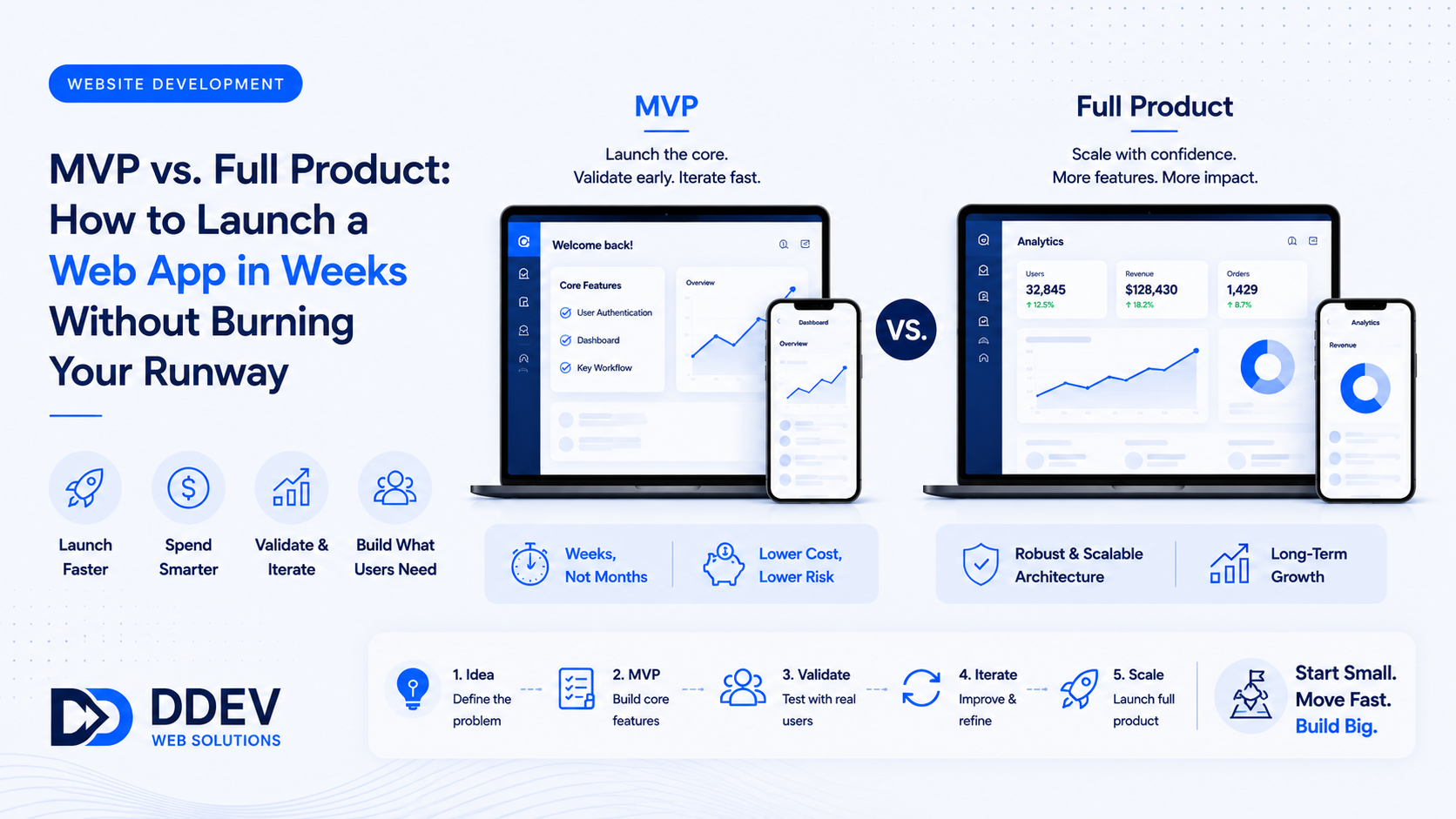
The most expensive mistake a startup can make is building a full product before validating that anyone wants it.
It happens constantly: a founder spends 6-9 months and ₹15-40 lakh building a feature-complete web application — only to discover that the core assumption was wrong, the market is different than expected, or the product solves a problem nobody was willing to pay for.
An MVP (Minimum Viable Product) is the opposite approach: build the smallest possible version that tests your core hypothesis, launch it in weeks, and let real user behavior guide what to build next.
The goal is not to launch a bad product. It is to launch a focused product that answers one question: "Do people want this enough to use it (and eventually pay for it)?"
MVP vs. Full Product: The Comparison
| Factor | MVP | Full Product |
|---|---|---|
| Build time | 3-8 weeks | 4-12 months |
| Cost | ₹2-8 lakh | ₹15-50 lakh+ |
| Features | Core functionality only | Full feature set |
| Risk | Low (validated early) | High (long build before validation) |
| User feedback | Immediate | Delayed by months |
| Iteration speed | Fast (weekly updates) | Slow (quarterly releases) |
The MVP is not a prototype or a mockup. It is a working product that real users can use — just with a narrow feature set focused on the core value proposition.
What Goes into an MVP (And What Does Not)
Include in the MVP
The core workflow. What is the one thing your product does better than alternatives? Build that. If you are building a project management tool, the MVP is task creation, assignment, and status tracking. Not Gantt charts, time tracking, and AI summaries.
Authentication. Users need to log in and have their data persist. This is table stakes.
A clean, usable UI. MVP does not mean ugly. A simple, well-designed interface builds trust and makes the product usable. It just means fewer screens and fewer features.
Analytics. You need to know how users behave — what they click, where they drop off, what they ignore. Build in basic analytics from day one.
Exclude from the MVP
"Nice to have" features. Integrations, dashboards, export tools, admin panels — add them when users ask for them, not before.
Scalability engineering. Your MVP will have 10-100 users, not 100,000. Do not engineer for scale you have not earned.
Perfection. Pixel-perfect animations, custom transitions, micro-interactions — these matter at scale, not at validation stage.
Multiple user types. If your product serves buyers and sellers, build the buyer experience first. Add the seller side after validating buyer demand.
The MVP Development Process
Week 1-2: Define and Design
Document the core user flow (the "happy path"), design wireframes for 5-10 key screens, define the tech stack (for most web apps: React + Node.js + PostgreSQL, or similar), and set up development infrastructure (repo, hosting, CI/CD).
Week 3-5: Build
Develop the core workflow end-to-end, build authentication and basic user management, implement the database schema for core functionality, and deploy to a staging environment for testing.
Week 6-8: Polish and Launch
Fix bugs from testing, add analytics tracking, optimize performance for mobile, deploy to production, and launch to a small group of target users.
Week 9+: Iterate
Collect user feedback (in-app, calls, surveys), analyze usage data (what gets used, what does not), prioritize features based on demand, not assumptions, and ship weekly updates.
How Much Does an MVP Cost in India?
| Type | Range | Timeline |
|---|---|---|
| Simple web app (form-based, CRUD operations) | ₹2-5 lakh | 3-5 weeks |
| Medium complexity (real-time features, third-party integrations) | ₹5-10 lakh | 5-8 weeks |
| Complex (multi-role, payments, dashboards) | ₹10-20 lakh | 8-12 weeks |
These ranges assume a professional development partner. A freelancer might be cheaper but slower and less reliable.
The key insight: an ₹5 lakh MVP that validates your idea in 6 weeks saves you from an ₹30 lakh full build that might need to be scrapped.
When to Graduate from MVP to Full Product
Your MVP has done its job when users are actively using it — not just signing up, but returning and engaging — you have paying customers or clear willingness to pay, you understand what to build next based on user behavior rather than guesses, and your core hypothesis is validated — the problem is real, the solution works.
At this point, you have the confidence (and ideally, the revenue or funding) to invest in a full product build — knowing exactly what features matter.
Frequently Asked Questions
Is an MVP just a prototype?
No. A prototype demonstrates a concept. An MVP is a working product that real users can use to accomplish a real task. It has a backend, stores data, and works reliably.
Can I build an MVP myself without technical skills?
Partially. No-code tools (Bubble, Glide) can create functional MVPs for simpler applications. But for anything with custom logic, integrations, or performance requirements, you need a developer or development partner.
What if my MVP fails?
That is the point. An MVP that proves your idea does not work has saved you 6 months and ₹20+ lakh compared to building the full product. Pivot, adjust, or try a different approach — with minimal sunk cost.
Launch Faster, Waste Less
DDev builds MVPs for startups — focused, fast, and functional web applications that validate your idea in weeks, not months. Core features only. Clean UI. Ready for real users.
Talk to DDev About Building Your MVP.